
Steel Structure Warehouse Span: How to Choose the Right Width for Your Project
Steel Structure Warehouse Span: How to Choose the Right Width for Your Project
When buyers start planning a steel structure warehouse, most conversations begin with two numbers: total floor area and budget. But there is a third number that quietly controls everything else — the span width. Get it wrong, and you end up with a warehouse that costs more than it should, stores less than you expected, or cannot fit the equipment your operation actually needs.
This guide explains exactly how steel structure warehouse span works, what drives the decision, how it connects to cost and crane requirements, and which span range makes sense for different types of storage and industrial operations.

What Is Warehouse Span — and Why Does It Matter?
Span refers to the horizontal distance a steel building bridges between its two rows of main columns — measured from centerline to centerline across the building width. In a single-span portal frame warehouse, there are no columns between the two exterior walls. The roof rafters arc from one side to the other in a single uninterrupted structure.
Span width directly determines: how many parallel storage aisles or production lines fit across the building; whether overhead cranes can operate without column interference; the size and weight of the primary steel frame — which is the main cost driver; and how easily the building can be repurposed or expanded in future.
Span is not just a dimension. It is a decision about how your warehouse will work for the next 30 to 50 years.
Single Span vs Multi-Span: The Fundamental Choice
Single Span (Clear Span) Steel Warehouse
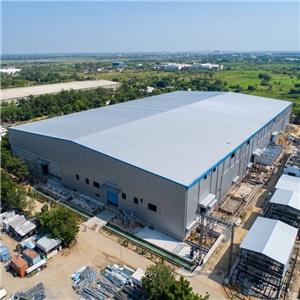
A clear span steel structure warehouse has no internal columns. The entire width of the building is open from wall to wall. This is the preferred choice for most logistics operators, distribution centers, and manufacturing facilities because it gives you total freedom over how you use the floor. With a clear span design you can run racking rows at any angle or spacing, reposition everything if your operation changes, operate wide-reach forklifts and automated guided vehicles without obstacle routing, and install overhead bridge cranes on runway beams that run the full building width.
Multi-Span Steel Warehouse
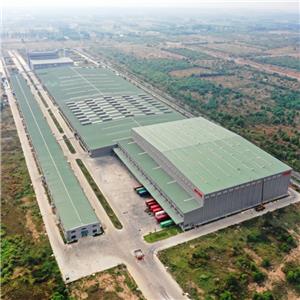
A multi-span warehouse places two or more portal frame bays side by side, sharing interior columns at the valley points between bays. Each individual bay stays within the economical single-span range, but the combined building footprint becomes much wider. Multi-span is the right choice when the total floor area required is very large, when the operation can tolerate interior columns, or when budget constraints make a very wide clear span unworkable.

| Factor | Clear Span | Multi-Span |
|---|---|---|
| Interior columns | None | Yes — at bay junctions |
| Layout flexibility | Maximum | Moderate |
| Structural cost (per m²) | Higher at wide spans | Lower for large widths |
| Best for | Logistics, cranes, automation | Large bulk storage |
| Crane operation | Full width coverage | Per bay only |
Common Span Ranges and Their Applications
| Span Range | Typical Use Cases | Crane Suitability |
|---|---|---|
| 12 m – 18 m | Small workshops, farm storage | Monorail hoist only |
| 18 m – 24 m | General warehousing, regional distribution | Bridge crane up to 10 T |
| 24 m – 36 m | E-commerce fulfillment, logistics hubs | Bridge crane up to 20 T |
| 36 m – 50 m | Heavy manufacturing, vehicle assembly | Double girder 20–50 T |
How Span Affects Cost
| Clear Span | Steel Weight (kg/m²) | Relative Cost Index | Notes |
|---|---|---|---|
| 18 m | 18–22 | 1.0× | Most economical |
| 24 m | 22–28 | 1.2–1.4× | Best balance for most projects |
| 30 m | 28–36 | 1.5–1.8× | Still portal frame |
| 40 m | 38–50 | 2.2–2.8× | Heavy portal frame |

Frequently Asked Questions
What is the most economical span for a steel structure warehouse?
For single-span portal frame construction, the most economical range is 18 m to 30 m. The sweet spot for most commercial warehousing is 24 m to 30 m — wide enough for three to four forklift aisles with racking on both sides, without the structural cost penalty of larger spans.
Can I add more span to my warehouse after it is built?
Width expansion after construction requires essentially rebuilding the primary frame. If width expansion is in your business plan, design for it now. It costs far less to build 6 m wider at the start than to add it later.
What is the maximum span without internal columns?
With standard portal frame construction, practical clear spans reach up to 50 m to 60 m. Beyond 60 m, structural truss or space frame systems are used and can achieve 80 m, 100 m, or more.
How does span affect foundation design?
Wider spans generate larger horizontal thrust at column bases, increasing the size of concrete pad footings and anchor bolt embedment depth. Always include foundation cost in your total project budget when comparing span options.
The Right Span Makes Everything Else Easier
At Meituo Buildings, our engineering team reviews your actual storage layout, equipment requirements, and future expansion plans before recommending a span. We do not suggest the widest building — we suggest the span that gives you the most value for your specific operation.
Send us your rough operational requirements and we will provide a free span recommendation with a structural layout sketch and indicative pricing within 3 business days.
Email: sales@meituobuildings.com
WhatsApp: +86 15910306877
Website: www.meituobuildings.com