
Multi-Span Steel Structure Warehouse Complex in Jubail Industrial City, Saudi Arabia — Petrochemical Equipment Storage
Project Overview
This multi-span prefabricated steel warehouse complex is located in Jubail Industrial City (Madinat al-Jubail al-Sinaiyah) in the Eastern Province of Saudi Arabia. The client is a Saudi engineering services company providing equipment storage, maintenance, inspection, and reconditioning services for the petrochemical and refining industry in the Eastern Province.
The facility required a large-area warehouse complex capable of storing large-format industrial equipment including pressure vessels, heat exchangers, pumps, compressors, and piping spools in various stages of inspection and reconditioning. A dedicated indoor maintenance and inspection workshop was required within the complex for equipment that needed controlled-environment inspection using precision measurement instruments.
The scale of the project — 15,000 square meters of covered space — and the demanding corrosion protection requirements applicable to a Saudi Aramco supply chain vendor made this one of Meituo Buildings' most technically demanding export projects to Saudi Arabia.
Project Specifications
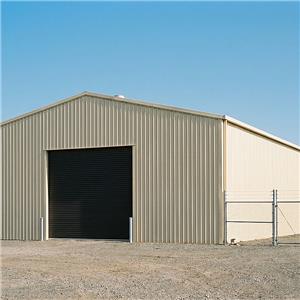
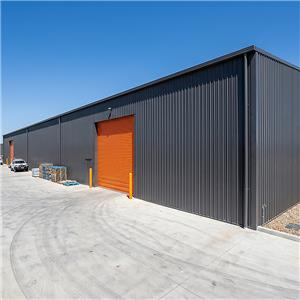
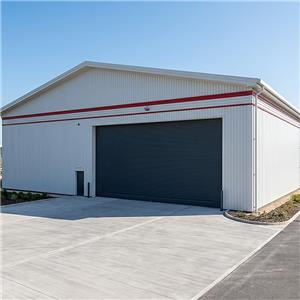
The complex consists of three connected building sections arranged on a common platform slab. Section A is the main equipment storage hall: 60 meters wide, 150 meters long, eave height 12 meters, single-span portal frame with 5-ton monorail hoists at 12-meter intervals. Section B is the maintenance and inspection workshop: 40 meters wide, 60 meters long, eave height 10 meters, equipped with a 15-ton overhead bridge crane. Section C is the covered laydown and staging area: 30 meters wide, 60 meters long, open-sided on the south elevation for heavy vehicle and crane access, with a 7-meter eave height.
Total covered area is 15,000 square meters. The three sections share a common valley gutter between A and B, and between B and C, with continuous rainwater drainage through internal downpipes to the perimeter drainage channel.
All primary structural steel is Q355B welded H-section. Primary frame members are shot-blasted to Sa 2.5 and coated with a zinc-rich epoxy primer at 60 microns, epoxy intermediate coat at 80 microns, and polyurethane topcoat at 60 microns — total dry film thickness 200 microns. This coating system is specified for C4 corrosivity category, appropriate for the Eastern Province industrial coastal environment of Jubail.
Saudi Aramco Corrosion Protection Compliance
As a supply chain vendor to Saudi Aramco and its joint ventures, the client was required to demonstrate that the facility met Saudi Aramco Engineering Standard SAES-H-001 for industrial building coating systems. Meituo Buildings prepared a coating compliance documentation package including paint product data sheets, application procedure specifications, inspector qualifications, and third-party dry film thickness inspection reports for each primary structural member.
All secondary framing — purlins, girts, bracing, cable trays, monorail beams, and crane runway brackets — was hot-dip galvanized to 450 grams per square meter coating weight. Hot-dip galvanizing was chosen for secondary members because the complex geometry of purlin sections and the numerous holes and slots in girts create areas that are difficult to coat uniformly by spray painting.
Anchor bolts throughout the complex were hot-dip galvanized and embedded in sulfate-resisting concrete with 85-millimeter minimum cover. The Jubail subsoil contains elevated sulfate concentrations associated with the sabkha (salt flat) geological conditions common in the Eastern Province coastal areas.
Overhead Crane and Material Handling Design
Section B, the maintenance workshop, is equipped with a 15-ton double-girder overhead bridge crane covering the full 40-meter span and 60-meter length of the workshop. The crane design incorporates a heavy-duty classification of A6 reflecting the intensive duty cycle of an active maintenance workshop, where the crane may be in continuous operation through two work shifts per day.
The crane runway beams are 900-millimeter deep welded H-sections with top flange reinforcement at 45-millimeter thick plate to distribute crane wheel loads. Runway beam splices are located at one-quarter span positions to minimize bending moment at the splice. Rail-to-beam attachment uses resilient rail clips that allow thermal expansion movement without introducing fatigue loads at the bolt connections.
Section A is equipped with five monorail hoists of 5-ton capacity, suspended from monorail beams spanning between adjacent portal frame bays. The monorails run longitudinally along the full 150-meter length of the storage hall, allowing equipment to be moved from the entrance loading area to any storage position and retrieved for delivery.
Roof Panel and Ventilation Design
Section A roof cladding uses 75-millimeter rockwool sandwich panels with white PVDF exterior faces. Rockwool was specified rather than PU foam in the storage hall because of the fire risk associated with hydrocarbon-contaminated equipment that may enter the facility for storage. Rockwool panels provide A1 fire classification, meeting the requirements of Saudi Civil Defense for storage buildings containing flammable materials.
Section B, the maintenance workshop, uses 75-millimeter rockwool roof panels for the same fire safety reasons. The workshop also requires mechanical exhaust ventilation to manage solvent vapors, metallic dust, and welding fumes generated during maintenance operations. An exhaust fan system with 12 roof-mounted industrial fans provides 6 air changes per hour in the workshop volume, maintaining fume concentrations below occupational exposure limits.
Section C, the open-sided staging area, has an insulated roof of 50-millimeter rockwool sandwich panels but no wall cladding on the south elevation, which is fully open for crane and vehicle access. The three remaining walls of Section C are clad with 50-millimeter rockwool panels to provide wind and rain protection.
Foundation and Ground Engineering
Geotechnical investigation at the Jubail site encountered sabkha (saline soft clay) at depths of 0.5 to 2.0 meters below the site surface. Sabkha soils have low bearing capacity and high sulfate content and are not suitable for supporting concentrated column loads without ground improvement or deep foundations.
The foundation design uses reinforced concrete bored piles of 600-millimeter diameter and 12-meter length, extending through the sabkha layer to competent load-bearing sand and gravel below. Each column foundation consists of three to four piles connected by a reinforced concrete pile cap. A grade beam system connects all pile caps to create a rigid foundation grid.
All below-grade concrete uses sulfate-resisting Portland cement (ASTM Type V) with a minimum cement content of 400 kilograms per cubic meter and a maximum water-cement ratio of 0.40, providing the dense, low-permeability concrete required to resist sulfate attack in the aggressive Jubail subsoil environment.
Construction Timeline
The extended foundation program, including pile installation and curing of pile caps and grade beams, required 45 days. Steel frame erection for all three sections took 24 days with a crew of 18 erectors and two mobile cranes. Roof and wall panel installation took 26 days. Crane installation, services, and external works took a further 20 days. Total construction time from site mobilization to client handover was 142 days.
Despite the extended foundation program, the total project duration was within the client's 150-day contract requirement. The ability to conduct steel fabrication in China simultaneously with foundation construction in Jubail was key to achieving this schedule.
Project Outcome
The complex entered operation on schedule and has been in continuous service as an equipment storage and maintenance facility for the Jubail petrochemical cluster. The Saudi Aramco vendor inspection audit of the facility confirmed compliance with SAES-H-001 coating standards and the facility was approved as a qualified storage and maintenance location in the Saudi Aramco vendor management system.
The project demonstrates Meituo Buildings' capability to deliver large, technically complex prefabricated steel warehouse structures to Saudi Arabia's most demanding industrial environments, including full compliance with Saudi Aramco engineering standards, appropriate corrosion protection for the Eastern Province coastal environment, and effective coordination of pile foundation design with the prefabricated steel superstructure supply.