
Steel Structure Warehouse Roof Types: Which One Is Right for Your Building?
Steel Structure Warehouse Roof Types: Which One Is Right for Your Building?
Most buyers spend a lot of time choosing their warehouse's span, height, and insulation — and then treat the roof as a minor detail left to the manufacturer. That is a mistake. Your steel structure warehouse roof is the largest surface area exposed to sun, rain, wind, and temperature extremes every single day. The wrong roof type, pitch, or panel system leads to leakage, condensation, heat buildup, and maintenance costs that accumulate across the building's entire service life.
This guide covers the main warehouse roof types used in steel buildings, what makes each one perform well or poorly in different climates and operations, and how to match your roof specification to your actual project needs — before you sign a contract.

Why the Roof Type Decision Matters More Than Most Buyers Realize
The roof of a steel structure warehouse does five critical jobs simultaneously: it sheds rainwater, resists wind uplift and snow load, controls heat gain in summer and heat loss in winter, prevents condensation from forming on the underside of steel panels, and supports any rooftop equipment such as ventilation fans and HVAC units.
A roof that fails at any one of these jobs creates real operational problems. A roof with the wrong pitch in a high-rainfall climate pools water at seams and leaks within a few years. A roof without proper insulation in a hot climate raises internal temperatures to levels that damage goods and compromise worker safety. A roof without ridge ventilation in a humid climate generates condensation that drips onto racking, forklifts, and inventory below.
Getting the roof specification right costs nothing extra at the design stage. Getting it wrong costs money every year of the building's operation.
The 4 Main Steel Structure Warehouse Roof Types
1. Single-Slope Roof (Mono-Pitch / Lean-To)
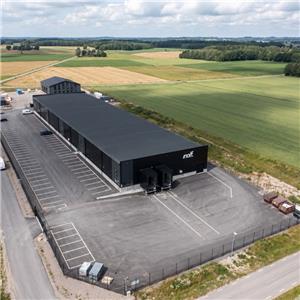
A single-slope roof runs at one consistent angle from one side of the building to the other — higher at one wall, lower at the opposite wall. All rainwater drains to the lower eave.
This is one of the simplest and most economical roof structures for steel warehouses. Because there is no ridge, there are fewer panel joints and flashings to seal. Water drainage is straightforward — all flow runs in one direction.
Best suited for:
Buildings that attach to an existing structure on the high side (lean-to extensions)
Sites with a natural slope where the low eave can drain directly to a channel
Small to medium warehouses up to 18 m to 24 m span
Buildings in moderate rainfall zones where drainage volume is manageable
Limitations: For wide buildings, a single slope creates a significant height difference between the two walls. A 30 m wide building with a 5-degree pitch has a wall height difference of about 2.6 m — which may be structurally inefficient and aesthetically awkward on exposed sites.
2. Double-Slope Roof (Gable / Saddle Roof)
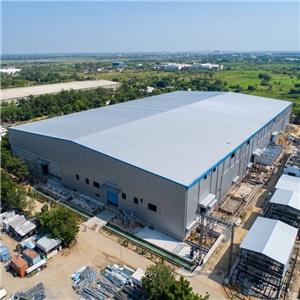
A double-slope roof has two pitching faces that meet at a central ridge, forming an inverted V shape when viewed from the end. Rainwater drains to the eaves on both sides of the building.
This is the most widely used steel warehouse roof type worldwide. It is structurally efficient across a wide span range, provides balanced drainage on both sides, and allows continuous ridge ventilation — which is essential for managing heat and humidity in industrial buildings.
Best suited for:
Standard industrial warehouses, logistics centers, and manufacturing workshops of any size
Buildings requiring continuous ridge ventilation for heat and condensation control
Wide-span structures from 18 m to 60 m and beyond
Multi-bay buildings where symmetrical drainage reduces gutter complexity
Why the ridge matters: The ridge point is where hot air naturally rises and accumulates inside the building. A continuous ridge vent running along the full length of the building allows this hot, humid air to escape passively — without mechanical fans. This reduces condensation risk, lowers internal temperatures in summer, and reduces the energy load on any mechanical cooling systems.
3. Multi-Span Valley Roof
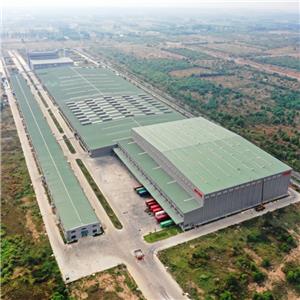
When a building is too wide for a single efficient portal frame span, multiple spans are placed side by side. Each span has its own two-slope roof, and the spans meet at internal valley gutters where adjacent roof faces drain inward.
This is the standard approach for very large warehouses and factory complexes. The structural advantage is significant: each individual bay can stay within the economical 18 m to 30 m span range, while the combined building footprint can extend to 60 m, 100 m, or more.
The critical issue with valley gutters: Internal valley gutters collect rainwater from two roof faces. If they are undersized, poorly sealed, or blocked with debris, the water backs up and leaks into the building — often damaging goods stored directly below. Valley gutters in large industrial warehouses require correct sizing, adequate fall, and regular maintenance access. This is one of the most common sources of warranty disputes in prefab steel building projects.

4. Arch Roof (Curved / Barrel Roof)
An arch roof follows a curved profile rather than a straight-line slope. The curve provides structural strength through shape rather than section depth — similar to how a stone arch carries load. This allows very wide clear spans with relatively light structural members.
Arch roofs are less common in standard industrial warehouses but are used in specific applications: large aircraft hangars, grain storage buildings, and sports facilities where maximum clear span without interior columns is the primary requirement.
For most commercial warehouse projects, the double-slope gable roof remains the most cost-effective and practical option. Arch roofs are typically specified when span requirements exceed what standard portal frame construction can achieve economically.
Quick Comparison: Which Roof Type for Which Project?
| Roof Type | Best Span Range | Drainage | Ridge Ventilation | Relative Cost | Best Use Case |
|---|---|---|---|---|---|
| Single slope | 12 m – 24 m | One direction | Not applicable | Lowest | Lean-to extensions, small depots |
| Double slope (gable) | 15 m – 60 m+ | Both sides | Continuous ridge vent | Standard | Most warehouses and factories |
| Multi-span valley | 60 m – 200 m+ total | External + valley gutters | Per bay ridge | Medium | Large complexes, multi-use facilities |
| Arch (curved) | 40 m – 120 m+ | Curved to eaves | Limited | Highest | Hangars, grain stores, sports halls |
Roof Pitch: The Number That Controls Water and Heat
Roof pitch — the angle of the roof slope measured in degrees — is the most underspecified detail in many warehouse projects. Buyers often accept the manufacturer's default without understanding what it means for drainage performance in their specific climate.
How Pitch Affects Drainage
The minimum roof pitch for a corrugated steel sheet roof to drain effectively is generally 5 degrees (approximately 1:12 rise-to-run ratio). Below this angle, rainwater moves too slowly along the sheet profile and backs up at laps and flashings — leading to leakage even with correctly installed panels.
In high-rainfall climates — equatorial Africa, Southeast Asia, and coastal South Asia — a pitch of 8 to 15 degrees is recommended to handle intense tropical rainfall events without overflow. In dry climates like the Arabian Peninsula and North Africa, a 5-degree pitch is usually adequate.
How Pitch Affects Internal Temperature
A steeper pitch creates a larger triangular void between the ceiling level and the ridge. In buildings without insulation, this void traps hot air during summer — which is undesirable. However, in buildings with a ridge vent, the larger void gives hot air more space to rise and exit through the vent, actually improving natural ventilation performance.
| Roof Pitch | Rainfall Performance | Ridge Vent Efficiency | Recommended Climate |
|---|---|---|---|
| 3° – 4° | Poor — risk of ponding | Low | Avoid unless site-constrained |
| 5° – 7° | Good standard drainage | Moderate | Dry and semi-arid regions |
| 8° – 12° | Excellent — handles heavy rain | Good | Tropical, subtropical, high rainfall |
| 15° – 20° | Excellent | Excellent | Snow-load zones or strong wind uplift areas |
Roof Panel Options: From Basic to High Performance
The roof panel system is the skin of the entire structure. It determines the building's thermal performance, fire rating, acoustic properties, and long-term maintenance requirements more than any other single component. Here are the main options used in modern steel warehouse roofs:
Single-Layer Corrugated Steel Sheet
A single profiled steel sheet — typically 0.4 mm to 0.6 mm thick — provides basic weather protection with no insulation. Economical, fast to install, and widely available. Suitable for dry material storage, agricultural sheds, and other applications where temperature control is not required.
Not suitable for: Occupied production areas in hot climates, food or pharmaceutical storage, or any application where condensation on the underside of the sheet would damage goods or processes below.
Glasswool or Rockwool Blanket with Single Sheet
A mineral wool blanket — typically 50 mm to 100 mm thick — is laid over the roof purlins before the outer steel sheet is fixed. This adds thermal resistance at low cost. Rockwool provides fire resistance up to A-grade; glasswool is slightly lighter and less expensive.
Key limitation: The purlins create thermal bridges — points where heat passes through the metal-to-metal contact without insulation. This reduces the effective thermal performance below the theoretical value of the blanket alone.
Sandwich Panel (EPS, Rockwool, or PU Core)
A sandwich panel bonds two steel face sheets around a continuous insulation core in the factory. Because the insulation is continuous with no thermal bridges, sandwich panels deliver the highest and most consistent thermal performance of any roof cladding option.
| Sandwich Panel Core | Thermal Performance | Fire Rating | Best Application | Relative Cost |
|---|---|---|---|---|
| EPS (foam) | Good | B-grade combustible | General storage, standard workshops | Lowest |
| Rockwool (mineral wool) | Good | A1 non-combustible | Fire-regulated buildings, food factories | Medium |
| PU (polyurethane) | Excellent — highest R-value | B-grade (add foil for B1) | Cold storage, pharmaceutical, clean rooms | Highest |
Ventilation: The Most Overlooked Roof Specification
A warehouse roof without adequate ventilation traps heat and moisture. Both problems are invisible until they cause damage — overheated inventory, condensation dripping from the underside of roof panels, mold growth on racking and stored goods, and rust forming on the inner faces of steel members.
The most effective and lowest-cost ventilation solution for steel warehouse roofs is a continuous ridge vent. This is a narrow opening — typically 100 mm to 300 mm wide — running along the full length of the roof ridge, fitted with a weather-protective cap. Hot air rises naturally from inside the building, accumulates at the ridge, and exits through the vent continuously without any power source.
Ridge vents work most effectively when paired with wall-level air inlets — typically adjustable louvers positioned low on the side walls. The inlet-to-outlet airflow pattern creates a stack effect that pulls fresh air in at low level and exhausts hot air at high level, even on still days with no wind.

When Mechanical Ventilation Is Needed
Natural ridge ventilation is sufficient for most dry goods storage warehouses. Mechanical ventilation is required when:
The building houses processes that generate significant heat, dust, or fumes (welding, chemical production, food cooking)
The building is in a location with very low wind speeds where natural stack effect is insufficient
Precise air change rates are required for food safety, pharmaceutical compliance, or GMP regulations
The roof is flat or very low pitch and ridge ventilation is not possible
Roof Specification Checklist Before You Order
Use this checklist when briefing a manufacturer for your steel structure warehouse roof specification:
| Item | Your Decision | Why It Matters |
|---|---|---|
| Roof type | Single slope / Double slope / Multi-span | Affects drainage direction, ridge ventilation, and structural system |
| Roof pitch | Minimum 5° for dry climates; 8°+ for tropical | Prevents water ponding and leakage at panel laps |
| Panel type | Single sheet / Blanket + sheet / Sandwich panel | Controls thermal performance, fire rating, and condensation risk |
| Panel thickness | 50 mm – 150 mm depending on climate and use | Determines insulation R-value and energy cost |
| Ridge ventilation | Continuous vent or closed ridge | Prevents heat buildup and condensation in the roof void |
| Skylights | FRP translucent panels: 5%–15% of roof area | Reduces daytime lighting cost; must be UV-resistant grade |
| Gutter sizing | Based on roof area and local rainfall intensity | Undersized gutters overflow and cause wall leakage |
| Roof color | White or light grey preferred for hot climates | High reflectivity reduces solar heat gain by up to 30% |
Frequently Asked Questions
What is the best roof type for a steel structure warehouse in a hot climate?
In hot climates such as the Middle East, West Africa, and South Asia, a double-slope gable roof with a continuous ridge vent, 75 mm to 100 mm polyurethane or rockwool sandwich panels, and a high-reflectivity white or light grey exterior coating is the best combination. The ridge vent exhausts accumulated heat passively, the sandwich panel blocks solar radiation, and the reflective coating reduces the heat absorbed by the panel surface.
How do I prevent leakage in a multi-span warehouse with valley gutters?
Valley gutters must be sized for the maximum expected rainfall intensity in the project location — not just average rainfall. They should be installed with a minimum fall of 1:400 toward the downpipe, fitted with leaf guards and access hatches for maintenance, and sealed with continuous EPDM or silicone at all joints. Undersized or poorly maintained valley gutters are the leading cause of water damage complaints in multi-span steel buildings.
What roof pitch should I specify for a warehouse in a tropical country?
For warehouses in tropical regions with heavy seasonal rainfall — including West Africa, Southeast Asia, and coastal South America — a minimum roof pitch of 8 degrees is recommended. A pitch of 10 to 12 degrees provides additional safety margin for intense short-duration rainfall events and reduces the risk of water backing up at panel laps during extreme storms.
Do skylights in steel warehouse roofs cause leakage problems?
FRP translucent skylight panels installed with correctly overlapped laps, sealed side joints, and compatible ridge and eave flashings do not cause leakage when properly installed. Problems arise when: the overlap is insufficient for the roof pitch, the side seals are omitted or use incompatible sealant, or the panels are positioned in low-pitch areas where water movement is slow. Always specify high-quality UV-stabilized FRP panels — cheaper grades yellow and become brittle within 5 years.
Get the Right Roof Specification for Your Warehouse — Free
At Meituo Buildings, we design every steel structure warehouse roof to match the actual climate, rainfall intensity, and operational requirements of the project location — not a generic standard specification. We ask the right questions before we design, so the roof performs correctly from day one.
Tell us your project location, building size, and what you plan to store or produce. Our engineering team will recommend the correct roof type, pitch, panel system, and ventilation configuration — and provide a layout drawing and price indication within 3 business days, at no charge.
Email: sales@meituobuildings.com
WhatsApp / Phone: +86 15910306877
Website: www.meituobuildings.com