
Prefab Steel Workshop with Overhead Crane in Jeddah, Saudi Arabia — Heavy Manufacturing Facility
Project Overview
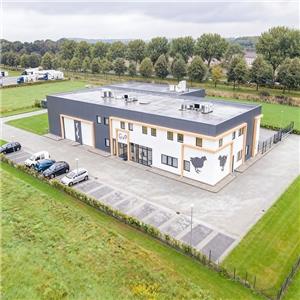
This prefab steel workshop project is located in the Second Industrial City of Jeddah, on the Red Sea coast of Saudi Arabia. The client is a metal fabrication company supplying structural steel components, pressure vessels, and mechanical equipment to oil and gas and power generation projects across the Red Sea region.
The project required a heavy-duty workshop building capable of housing multiple CNC cutting machines, plate rolling equipment, welding stations, heat treatment furnaces, and a 20-ton overhead bridge crane for moving large fabricated assemblies between work stations and to the loading area. The workshop also required an integrated quality control inspection bay and a small office and changing room block.
Meituo Buildings supplied the complete pre-engineered steel structure system, including the primary frame designed for the 20-ton crane loads, crane runway beams and end stops, all secondary framing, insulated panel cladding, industrial doors, ventilation system, and the full set of structural engineering drawings stamped by a licensed structural engineer.
Project Specifications
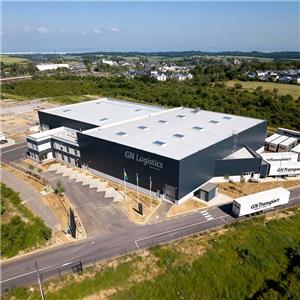
The workshop has a total floor area of 4,800 square meters. The building is 40 meters wide and 120 meters long, arranged in five portal frame bays of 24 meters. The eave height is 12 meters, providing sufficient hook height for the 20-ton overhead bridge crane while maintaining a safe 1.2-meter clearance between the maximum hook position and the underside of the crane runway beam.
The primary structural frame uses welded H-section columns and rafters of Q355B structural steel. Column sections are 600 millimeters deep with 250-millimeter flanges, selected for the combined vertical load from the roof and the horizontal moment from crane operation. Rafter sections are 700 millimeters deep at mid-span, reducing to 400 millimeters at the ridge and column connections, optimized for the portal frame bending moment distribution.
Crane Runway Beam Design
The 20-ton overhead bridge crane required careful structural design of the crane runway beams and their connection to the main columns. The runway beams are fabricated from 800-millimeter deep welded H-section steel with top flange reinforcement to distribute the concentrated wheel loads from the crane bridge. Runway beams are connected to crane brackets welded to the inner face of the main columns at a height that provides the required hook height under the crane hook at maximum lift.
Fatigue category classification of the crane was confirmed as A5 in accordance with FEM classification, reflecting the moderate to heavy duty cycle of the fabrication workshop. Crane runway beam connections and column bracket welds were designed to the fatigue loading requirements appropriate for this classification, ensuring long-term structural reliability under repeated crane loading cycles.
Crane runway alignment was checked after primary frame erection and before crane installation using optical survey equipment. Rail straightness and gauge were confirmed within the crane manufacturer's specified tolerances before the crane bridge was installed.
Coastal Anti-Corrosion Engineering
The Jeddah coastal environment presents significantly elevated corrosion risk for steel structures compared to inland Saudi Arabia locations. Salt-laden air from the Red Sea, combined with Jeddah's year-round high humidity, creates conditions classified as C4 corrosivity category under ISO 12944.
For the primary structural steel, the surface treatment specification was: shot blast to Sa 2.5, apply 80-micron zinc phosphate epoxy primer, apply 80-micron epoxy intermediate coat, apply 60-micron polyurethane topcoat — total dry film thickness 220 microns. This system provides a design life to first maintenance of 15 years in the C4 environment of coastal Jeddah.
Secondary framing, including purlins, girts, bracing, and crane runway beam connections, was hot-dip galvanized to a zinc coating weight of 450 grams per square meter, providing enhanced corrosion protection at connections and in areas where paint coating can be damaged by construction activity.
All anchor bolts were hot-dip galvanized and embedded in concrete with a minimum cover of 75 millimeters. Stainless steel bolts were used at the connection between the column base plate and the anchor bolt nuts, where bimetallic corrosion is a risk.
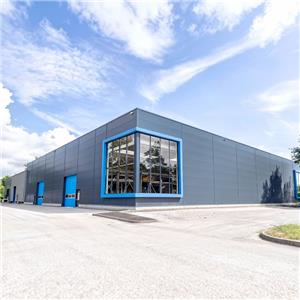
Roof and wall cladding uses 75-millimeter rockwool sandwich panels with PVDF-coated exterior faces in a light grey color. Rockwool was selected for this project in preference to PU foam because of its non-combustibility, which is important in a workshop environment where hot work operations including welding and cutting create an elevated fire risk.
Ventilation Design for Welding Workshop
A heavy fabrication workshop that operates multiple welding stations continuously generates significant quantities of welding fume, metallic dust, heat from cutting and welding operations, and occasional solvent vapor from surface preparation activities. The building ventilation system was designed to manage all of these contaminants.
Ridge ventilation of 900-millimeter opening runs the full length of the building, providing continuous natural exhaust of heat and buoyant fumes. Motorized wall louvers of 1,500 millimeters by 1,200 millimeters are positioned at low level on the north and south walls at 6-meter intervals, providing fresh air supply when open.
For welding stations, local extraction hoods connected to a roof-mounted extraction fan system provide source capture of welding fume before it disperses into the general workshop atmosphere. This local extraction system significantly reduces the whole-building ventilation requirement compared to dilution ventilation alone.
A separate air-conditioned quality control inspection bay of 300 square meters at one end of the workshop provides a clean, controlled environment for dimensional checking of finished fabrications using precision measurement equipment.
Construction and Delivery
All steel components were fabricated at Meituo Buildings' manufacturing facility in China, packed in standard 40-foot containers, and shipped to Jeddah Islamic Port. Sea transit time was 22 days. Customs clearance at Jeddah port was completed in 4 days with all documentation in order.
Local foundation construction was completed by a Jeddah-based civil contractor during the fabrication period. The foundation layout was confirmed using Meituo Buildings' anchor bolt layout plan before concrete pouring. All column base anchor bolts were surveyed and confirmed within tolerance before the steel erection crew mobilized.
Primary frame erection took 18 days for a crew of 12 steel erectors with a 70-ton mobile crane. The crane runway beams and rails were installed and surveyed during the final 3 days of frame erection. Panel installation was completed by a local cladding subcontractor in 14 days following frame completion.
Total construction time from site mobilization to handover was 112 days.
Project Outcome
The workshop has been in continuous production since handover, fabricating structural steel components, pressure vessels, and mechanical assemblies for energy sector clients in Saudi Arabia and the wider Red Sea region. The 20-ton crane has performed reliably throughout the first year of operation with no structural issues reported.
The client has subsequently engaged Meituo Buildings for a second workshop building expansion on the adjacent plot, adding 2,400 square meters of additional fabrication space with a 10-ton crane to support increased production volume.